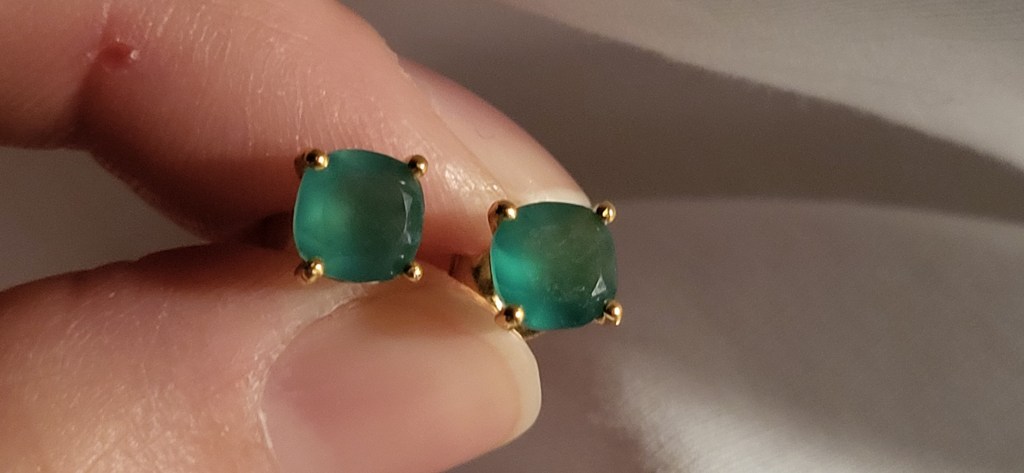
Chrysoprase means ‘golden leek’ in Greek antiquity. Its colors are apple green, light green and vibrant green.
A gem often used for its many virtues, chrysoprase stone is considered a love stone and is associated with the heart chakra. It is a natural remedy against insomnia and was used to detect poison, making this a very versatile stone.
It is one of the most ancient semi-precious stones used by man throughout history and is well-known for its psychological and physical virtues. Indeed, many studies have demonstrated that ancient peoples such as the Greeks, Romans or Egyptians made daily use of it: for example, in the crafting of seals or jewels, but also of many other objects, whether for its beneficial or simply aesthetic virtues.
Traces of this can be found in the various historical accounts that remain, regardless of how ancient they may be: not only do we find a description of chrysoprase in the work ‘Natural History’ by Pliny the Elder (23–79 AD), famous Roman writer and naturalist, it more importantly features in a Bible passage which describes the city of New Jerusalem in detail: its streets, its houses and its public buildings. Its traces are found in the foundation of the city walls which is made of many precious stones.
Albertus Magnus wrote that the legendary Alexander the Great (356 BC – 323 BC), King of Macedonia and Greek conqueror, always wore one in his belt whilst in battle, evidently for good fortune and military victory. He believed that it fostered wisdom and helped him to make the right decisions during important strategic campaigns.
This until the day when, wanting to cross a river, a snake suddenly appeared and bit Alexander’s saddle: in the midst of the action, the indispensable amulet fell in the water. One can predict the rest of the story: the unfortunate encounter was a bad omen for him, who, unable to find the stone despite his searching, could never win a single battle again…
Much later, in the Middle Ages, it was believed to possess powers of invisibility: for this, it had to be held in the mouth. Others saw it as a stone which could detect poison. For example, if the stone turned colourless, it would indicate the presence of poison not far from oneself. It was also common knowledge that the famous green stone had the power to relieve certain ailments such as gout.
Of course, Alexander the Great was not the only one with a special interest in chrysoprase stone: Frederick II of Prussia adored it so much that he wanted to use it for the decoration of his palace; no doubt the semi-precious stone must have conformed well to the aesthetic codes of his time, as even parts of his furniture were embellished with chrysoprase.
Throughout each period of history, it found very specific uses: in antiquity, the Middle Ages, and also during the Victorian era! During the latter period, it was worn on many necks and fingers, i.e. for cameos, intaglios, beads or cabochons!
http://www.minerals-kingdom.com/stones-virtues/chrysoprase-stone/











 Candid Corvid Productions